Thursday, May 3, 2012

Northampton Skyline Near Smith College

Click image to enlarge


This drawing is of the Northampton skyline near Smith college. The tower with the flag is the bell tower at the entrance of the college. The view is from State Street, near the corner of Button street,  looking west.  The drawing measures 7.25" x 10.5" on 8.5"  x 12 " watercolor paper, and is drawn with sepia wax pencil. The  paper  has a slightly rusticated surface do to its being painted first and some fine brick dust pressed into the surface.  I prepare the paper this way for several reasons. First it makes the surface stone like, as is the subject matter, secondly it gives the paper a beautiful tint.  Also, a drawing done this way is unlike any reproduction of which we see billions. The surface has an identity, like a fingerprint, or like the texture of the surface of polished marble.  I have included a detail of the surface below.  This is just the sky in the right hand top, though there is nothing there, you can see that it is lively with fine textures and tints like an abstract painting. The drawing is signed and dated along the bottom, Richard Britell,  2002.  


Wednesday, April 18, 2012

A Victim Of The French Revolution

Click Image To Enlarge


The thing about architecture of this period is that every square inch of the edifice was attended to with the same minute devotion. This drawing approaches the subject with the same attitude. In a work of this sort you will not find anything artistically unfinished or scribbled over as in the vignettes of the 19th Century. From the grass among the loose rubble to the single overhanging stone everything is look at with the same attention. Even so, if you look at details carefully you will be able to detect my left-handedness in the direction of the strokes of the shading. A two point perspective rendering, done with hb graphite pencil, on hot press Arches watercolor paper. Image size 10.5" x 7.75" Signed and dated across the bottom, Richard Britell, April 2012, an original drawing.

Some information about Jumieges Abbey ruins:  The abbey was founded in 654 by Saint Philibert, who had been the companion of Saints Ouen and Wandrille at the Merovingian court. Philibert became first abbot but was later on, through the jealousy of certain enemies, obliged to leave Jumièges, and afterwards founded another monastery at Noirmoutier, where he died in about 685. Under the second abbot, Saint Achard, Jumièges prospered and soon numbered nearly a thousand monks.
In the ninth century it was pillaged and burnt to the ground by the Vikings, but was rebuilt on a grander scale by William Longespee, Duke of Normandy (d. 942). A new church was consecrated in 1067 in the presence of William the Conqueror.
Enjoying the patronage of the dukes of Normandy, the abbey became a great centre of religion and learning, its schools producing, amongst many other scholars, the national historian, William of Jumièges. It reached the zenith of its fame about the eleventh century, and was regarded as a model for all the monasteries of the province. It was renowned especially for its charity to the poor, being popularly called "Jumièges l'Aumônier".
The church was enlarged in 1256, and again restored in 1573. The abbots of Jumièges took part in all the great affairs of the church and state. One of them, Robert Champart, became Archbishop of Canterbury in 1051, after being Bishop of London. Many others became bishops in France, and some were also raised to the dignity of cardinal.
The fortunes of the abbey suffered somewhat through the English invasion of the fifteenth century, but it recovered and maintained its prosperity and high position until the whole province was devastated by the Huguenots and the Wars of Religion. In 1649, during the abbacy of Francis III, Jumièges was taken over by the Maurist Congregation, under which rule some of its former grandeur was resuscitated.
The French Revolution, however, ended its existence as a monastery, leaving only impressive ruins.


Friday, April 6, 2012

Cathedral of Notre Dame De Brebieres, wash drawing on prepared paper


This is an original drawing on prepared paper of the cathedral called Notre Dame of Brebieres, which was destroyed in World War I and later rebuilt.  The drawing measures 8.6" x 6.2", and is signed and dated across the bottom as can be seen in the enlargement above.

Some information about this historical site below:

During World War I, the statue of Mary and the infant Jesus - designed by sculptor Albert Roze and dubbed the "Golden Virgin" - on top of the Basilica of Notre-Dame de Brebières was hit by a shell on January 15, 1915, and was put on a horizontal position and was near falling. The Germans said that whoever made the statue fall would lose the war, and a number of legends surrounding the "Leaning Virgin" developed among German, French, and British soldiers. The Leaning Virgin became an especially familiar image to the thousands of British soldiers who fought at the Battle of the Somme (1916), many of whom passed through Albert, which was situated three miles from the front lines.
In his letters home to his wife, Rupert Edward Inglis (1863–1916), who was a former rugby international and now a Forces Chaplain, describes passing through Albert:
We went through the place today (2 October 1915) where the Virgin Statue at the top of the Church was hit by a shell in January. The statue was knocked over, but has never fallen, I sent you a picture of it. It really is a wonderful sight. It is incomprehensible how it can have stayed there, but I think it is now lower than when the photograph was taken, and no doubt will come down with the next gale. The Church and village are wrecked, there’s a huge hole just outside the west door of the Church.
The German army recaptured the town in March 1918 during the Spring Offensive; the British, to prevent the Germans from using the church tower as an observation post, directed their bombardment against the basilica. The statue fell in April 1918 and was never recovered. In August 1918 the Germans were again forced to retreat, and the British reoccupied Albert until the end of the war.
Albert was completely reconstructed after the war, including widening and re-orienting the town's main streets. The Basilica, however, was faithfully rebuilt according to its original design by Eduoard Duthoit, the son of the architect who had overseen its construction in 1885-95. The present statue is an exact replica of Roze's original design, and a war memorial designed by Roze and featuring an image of the "Leaning Virgin" can be seen in the "Abri" (Shelter) Museum, which houses souvenirs of the war. The underground shelters in which the museum is located served as protective bunkers for Albert's residents during aerial bombardments in World War II.

Thursday, March 29, 2012

The Dakota, 72nd Street, New York City


This is an original drawing in pencil. The paper is not white, it has been tinted with watercolor to a light tan similar to the trim color of the building. This style of drawing is considered an architectural rendering. The drawing measures 9.125" x 12.25"

The subject is famous Dakota apartment building in upper Manhattan, this is the 72nd street entrance. It has been rendered with an hb pencil on hot press watercolor paper. Under the tint are two coats of white gesso for luminosity. This drawing is signed and dated across the bottom, Richard Britell March 2012

Some information about this famous building:

The Dakota, constructed from October 25, 1880 to October 27, 1884, is a co-op apartment building located on the northwest corner of 72nd Street and Central Park West in the Upper West Side of Manhattan in New York City, at 1 West 72nd Street, New York, NY 10023.

The architectural firm of Henry Janeway Hardenbergh was commissioned to create the design for Edward Clark, head of the Singer Sewing Machine Company. The firm also designed the Plaza Hotel.

The building's high gables and deep roofs with a profusion of dormers, terracotta spandrels and panels, niches, balconies, and balustrades give it a North German Renaissance character, an echo of a Hanseatic townhall. Nevertheless, its layout and floor plan betray a strong influence of French architectural trends in housing design that had become known in New York in the 1870s.

According to often repeated stories, the Dakota was so named because at the time it was built, the Upper West Side of Manhattan was sparsely inhabited and considered as remote as the Dakota Territory. However, the earliest recorded appearance of this account is in a 1933 newspaper story. It is more likely that the building was named "The Dakota" because of Clark's fondness for the names of the new western states and territories. High above the 72nd Street entrance, the figure of a Dakota Indian keeps watch. The Dakota was added to the National Register of Historic Places in 1972, and was declared a National Historic Landmark in 1976.

Saturday, May 8, 2010

Fear of Gypsies


This is a work in progress. Julia Britell is the model, but the features have been adjusted to fit the idea of the painting. When Julia was a child she was afraid of gypsies. This fear was aggravated by the fact that she liked to listen to the song, "The Raggle Taggle Gypsies O". In the painting the dress represents the idea of the Gypsies, or at another level, all of the infinite influences over time, that compose a personality.

This is in the under painting stage, and when finished will measure 64" x 18", or life sized. Oil on canvas, May, 2010, Richard Britell

Friday, February 5, 2010

Richard Britell, "Fox and Parking Meter", oil on canvas 30" x 48", February, 2010


Things in this painting:  A red fox, two urns, a parking meter, a fire hydrant, and a parked car.  The parked car is out of focus, and the hydrant is blocked out by the urn.  These are all various parts of a banister, an imaginary banister on the top of an imaginary building.  Down below are crowds of imaginary people rushing too and fro, along Fifth Avenue, just two blocks south of the Metropolitan Museum.  


I would like to say a few things about the symbolism of this painting.  First of all there is the red fox, which is a symbol of a fox.  Then comes the parking meter, which is a symbol of a parking meter.  You can figure out the symbolism of the urns for yourself, but i will give you this clue.  They are either very large urns in which can be grown those wonderful dwarf orange trees, or they are funeral urns.


Now I would like to say something about my procedures in doing this painting.  Before I began I consulted the very best animal painting that I know of, which is Durer’s portrait of a rabbit;  I am sure you know the one.  I looked at this very carefully and I noted that the rabbit is painted in such a way that you can practically see every single hair on its body.  This was a rabbit who was willing to spend a long time posing , in daylight, standing stock still for his portrait to be done.  This was exactly what i did not want to do in my painting.  I wanted my fox to look like one of those foxes you see running along the side of the road, at night, and you only get to see a little light glinting along the edge of his eye, as he bounds along in the darkness.  For this sort of thing one has to consult Caravaggio, or perhaps the x-files, where things are sucked up in shadow, or obscured by mist.


Thursday, January 7, 2010

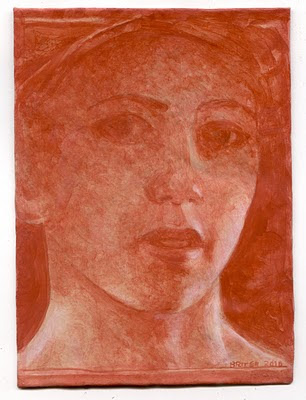
Portrait of Amy Climo, from directions of Cennini

click image to enlargeRichard Britell "Amy Climo" acrylic and silver point on copper panel, 8" x 5.5" 2010

From "The Crafteman's Handbook", of Cennino Cennini

How you Should Regulate Your Life in the Interests of Decorum and the Condition of Your Hand; And in What Company; And What Method You Should First Adopt for Copying a Figure From High Up .
Chapter XXVIIII
Your life should always be arranged just as if you were studying theology, or philosophy, or other theories, that is to say, eating and drinking moderately, at least twice a day, electing digestible and wholesome dishes, and light wines; saving and sparing your hand, preserving it from such strains as heaving stones, crowbar, and many other things which are bad for your hand, from giving them a chance to weary it. There is another cause which, if you indulge it, can make your hand so unsteady that it will waver more, and flutter far more, than leaves do in the wind, and this is indulging too much in the company of woman.
Always go out alone, or in such company as will be inclined to do as you do, and not apt to disturb you. And the more understanding this company displays, the better it is for you. When you are in churches or chapels, and beginning to draw, consider, in the first place, from what section you think you wish to copy a scene or figure; and notice where its darks and half tones and high lights come; and this means that you have to apply your shadow with washes of ink; to leave the natural ground in the half tones; and to apply the high lights with white lead.
First take the charcoal, slender, and sharpened like a pen, or like your style; and, as the prime measurement which you adopt for drawing, adopt one of the three which the face has, for it has three of them altogether: the forehead, the nose, and the chin, including the mouth. And if you adopt one of these, it serves you as a standard for the whole figure, for the buildings and from one figure to another; and it is a perfect standard for you provided you use your judgment in estimating how to apply these measurements. And the reason for doing this is that the scene or figure will be too high up for you to reach it with your hand to measure it off. You have to be guided by judgment; and if you are so guided, you will arrive at the truth. And if the proportion of your scene or figure does not come out right at the first go , take a feather, and rub with the barbs of this feather--chicken or goose, as may be--and sweep the charcoal off what you have drawn. That drawing will disappear. And keep starting it over from the beginning until you see that your figure agrees in proportion with the model. And then, when you feel that it is about right, take the silver style and go over the outlines and accents of your drawings, and over the dominant folds, to pick them out. When you have got this done, take the barbed feather once more, and sweep the charcoal off thoroughly; and your drawing will remain, fixed by the style.
How You should Draw and Shade with Washes on Tinted Paper, and Then Put Lights on With White Lead.
Chapter XXXI
When you have mastered the shading, take a rather blunt brush; and with a wash of ink in a little dish proceed to mark out the course of the dominant folds with this brush; and then proceed to blend the dark part of the fold, following its course. And this wash ought to be practically like water, just a little tinted, and the brush ought to be almost always practically dry. Without trying to hurry, go on shading little by little, always going back with this brush into the darkest areas. Do you know what will come of it? --If this water is just a little tinted, and you shade with enjoyment, and without hurrying, you will get your shadows well blended, just like smoke. Remember always to work with the flat of the brush. When you have gone as far as you can with this shading, take a drop or two of ink and put it into this wash, and mix it up well with this brush. And then in the same way pick out the very bottoms of those folds with this brush, picking out their foundations carefully; always remembering your shading, that is, to divide into three sections: one section, shadow; the next, the color of your ground; the next, with lights put on it. When you have got this done, take a little white lead well worked up with gum Arabic. [I will explain this to you later on, how this gum is to be dissolved and melted: and I will explain about all the temperas.] Ever so little white lead in the little dish, especially if this is dried up. Then dress it on the back of your hand or your thumb, shaping and squeezing out this brush, and getting it empty, practically draining it. And begin rubbing the brush flat over and into the areas where the high light and relief are to come; and proceed to go over them many times with your brush, and handle it judiciously. Then, for the accents of the reliefs, in the greatest prominence, take a pointed brush, and touch in with white lead with the tip of this brush, and crisp up the tops of these high lights. Then proceed to crisp up with a small brush, with straight ink, marking out the folds, the outlines, noses, eyes, and the divisions in the hairs and beards.
How You may Put on Lights with Washes of White Lead Just as You Shade with Washes of Ink.
Chapter XXXII
I advise you, furthermore, when you get to be more experienced, to try to put on lights perfectly with a wash, just as you do the wash of ink. Take white lead ground with water, and temper it with yolk of egg; and it blends like an ink wash, but it is harder for you to handle, and more experience is needed. All this is known as drawing on tinted paper, and it is the path to lead you to the profession of painting. Follow it constantly as much as you can, for it is the essence of your study. Apply yourself to it enthusiastically, and with great enjoyment and pleasure.